
12 Conversations Every Father Should Have With His Son Before 18
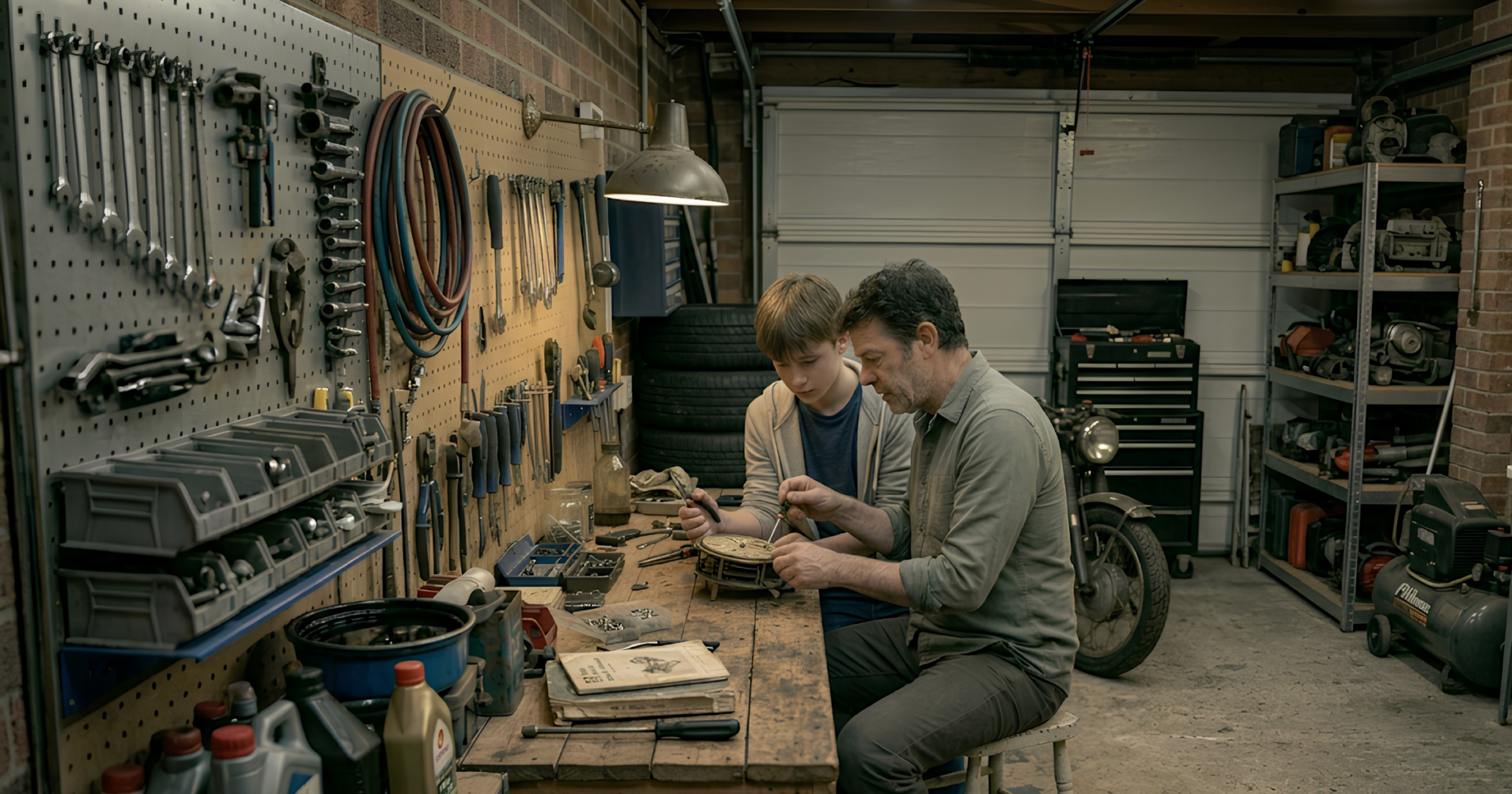
Most fathers know the conversations they should be having with their sons. Most fathers put them off until the moment passes.
It is not because they do not care. It is because the conversations are hard, the timing never feels right, and the boy in front of them keeps changing faster than the script in their head.
Here are twelve conversations that matter more than the rest. Most belong to a specific age window. A few can be revisited many times. None of them are easy. All of them are recoverable if you start late.
The principle behind all twelve
Before the list, one thing is worth saying.
Boys talk more easily when no one looks at them. Cars, walks, washing the car, and fixing something together. Eye contact raises the cost of speaking. Side-by-side lowers it.
If you remember nothing else from this post, remember the seat next to him is the most useful seat in the house.
Now the twelve.
1. The body
Age: 10 to 11. Before the changes start.
He needs to hear about puberty from you before he hears it from the internet or a kid in his year who has already worked some of it out. The point is not to deliver the whole speech in one sitting. The point is to make his body a normal topic, not a forbidden one.
Start short. Five minutes. In a car. End it with: “If anything weird happens and you do not know what it is, you can ask me. I will not make it a big deal.”
The next conversation gets easier if this one goes well.
2. Friends and who is actually on his side
Age: 11 to 13. As middle-school hierarchies form.
This is the age where boys start mistaking popularity for friendship. The cost of getting that wrong is years invested in a group that will not show up when it matters.
Do not name names. Do not lead with criticism of his friends. Ask the above question: “What would you tell me about a friend who only treats you well when no one is watching?”
He will think about it for weeks.
The second half of this conversation is the one most fathers skip: it is not just about the friends he keeps, but about the friend he is. The boy who notices the quiet kid at the lunch table, who checks on the one who has gone silent for a week, who asks how a friend is actually doing instead of accepting “fine”, that is the boy who will not be alone at twenty-five. Tell him this directly. Most boys do not hear it.
3. Money and the cost of a life
Age: 13 to 15. Before he has a regular income.
Most boys do not know what a household costs to run, what an hour of work is worth, or the difference between earning and being given. The gap between not knowing and finding out the hard way is where early financial mistakes live.
Have this conversation while doing a paid task together, ideally one you are paying him for. Tell him what things actually cost. Tell him what your bills add up to in a month. Tell him what an hour of his time is worth right now, and what it could be worth at twenty-five.
This is not a financial literacy lecture. It is a values transfer. The lesson is that work is not punishment. It is the price of the life he wants.
4. Pornography
Age: 12 to 14. Earlier if he has unrestricted internet access.
He will see it. The only question is whether he meets it with context or without.
Have the conversation in a car. Eyes forward. Open with: “I want to talk to you about pornography. Not because I think you are looking at it. Because I want you to know what it actually is before you make assumptions.”
Tell him what it is: actors, scripts, edits, performance. Tell him what it is not: a guide to real intimacy, to women, or to his own body. Tell him that if he has already seen it, he is not in trouble. Tell him that if he starts seeing it regularly, you want him to be able to tell you without it being a big deal.
The boys who get this conversation make different choices than the ones who do not.
5. Substances
Age: 13 to 15. Before the first party where it is on offer.
Most boys lie to their parents about their first encounter with alcohol or weed because they assume the parent will overreact. Removing the lie is more useful than preventing the encounter.
Open with: “I am not going to ask you whether you have tried any of this. I am going to tell you what I would want to know in your position, and you can do whatever you want with the information.”
Then the deal: “If something goes wrong, anywhere, any time, you can call me. No questions until the next morning. I will come and get you.”
That sentence is the most important one a father gives a teenage son. Mean it. Honor it the first time he tests it. Everything else flows from that.
6. Girls, respect, and consent
Age: 13 to 15. Before he is in a relationship.
Most boys learn about consent from peers, from pornography, or not at all. Each of those is worse than learning it from you.
The lines that matter:
- A girl is a person, not a puzzle to solve.
- Consent is not the absence of no. It is a clear yes. Anything else is not consent.
- A drunk yes is not a yes. A yes that came after pressure is not a yes.
- How he talks about girls with his friends shapes how he treats them in person.
He will not respond much during the conversation. That is fine. You will see whether it landed in how he behaves six months later.
One practical line worth adding before you finish: taking responsibility for protection is part of treating a girl as a person, not a puzzle. He should carry his own. Not as a trophy. As a baseline.
7. Losing
Age: throughout.
Boys are taught how to win. Few are taught how to lose.
He will lose games, friends, places on teams, first girlfriends, first jobs. Some of those losses will feel like they are about him when they are not. Some will feel like they are not about him when they are.
The conversation worth having: losing is information. Sometimes the information is “that was not for me.” Sometimes it is “I have work to do.” Sometimes it is “the world is unfair and that is true and I still have to keep going.” The skill is being able to tell which one, and not collapsing the categories.
He will not get this right at fourteen. He needs to hear it anyway, because he will remember it at twenty-four.
8. What it means to be a man
Age: 14 to 16. As he starts looking for a model outside the home.
If you do not give him a definition, the internet will. The internet’s definitions are mostly bad.
Open with: “There are a lot of voices online right now telling boys what it means to be a man. Most of them are selling something. I want to tell you what I think, and then I want to hear what you think.”
What to cover, briefly:
- Strength is discipline, not aggression.
- Vulnerability is a feature of strong men, not a flaw.
- Taking responsibility for things that are partly your fault is the start of becoming an adult.
- The men he most wants to be like are usually the quietest ones.
Make space for him to disagree. Ask: “Who is a man you actually respect, and why?” The answer will tell you more about where he is than anything else he says all year.
9. Failure that was his fault
Age: 14 to 16. After his first significant public failure.
Boys who never see their fathers fail learn that failure is a thing to hide. Boys who see their fathers fail and recover learn that failure is a thing to walk through.
Tell him about a real failure of yours. Briefly. What happened, what it felt like, and what you did next. Keep the focus on the recovery, not the wound.
Then ask him the only useful question: “What is the part of what happened that you can do something about?”
That sentence does more for a boy than a thousand reassurances.
10. Grandparents and aging
Age: any. Best had repeatedly.
Most fathers do not have this conversation. Most sons regret not having had it.
His grandparents will not always be here. They have stories he has not asked for, skills he has not noticed, and a perspective on his father that no one else in the world can give him. The window for him to access any of that is finite, and shorter than he thinks.
The conversation does not need to be heavy. It can be: “Have you ever asked your grandfather what his first job was?” Or: “What do you actually know about how your grandmother grew up?”
Most boys cannot answer either question. That is the conversation.
11. When something is really wrong
Age: 14 to 17, and then again, and again.
Boys are statistically far less likely than girls to ask for help when they need it. This is the standing offer that he can.
Have it once, plainly: “If something is ever really wrong, at school, with a friend, in your head, I want you to be able to tell me. I will not panic. I will not make it about me. I will help you figure out the next step.”
Then mean it. The first time you panic, lecture, or tell someone else, the offer is broken for good. Make the offer, then make it again three months later, and again three months after that.
Boys do not use the offer the day you make it. They use it the day they need it. Sometimes that day is years away.
One thing worth telling him quietly, in passing, well before the day comes: anger is almost always a cover for something else. Fear of failing. Hurt that has not been named. Embarrassment he cannot put down. If he can learn to ask himself “what am I actually afraid of right now?” in the moment, he will save himself a decade of trouble. Most men learn this in their thirties. Teach it to him at fifteen.
12. Leaving home
Age: 16 to 18. Spread across many conversations, not one.
Most boys are taught how to drive, how to take a test, and how to fill out an application. Few are taught how to live alone.
The list you want him to take with him:
- How to cook five meals.
- How to do laundry without ruining anything.
- How to read a contract before signing it.
- What to do if he runs out of money before the end of the month.
- How to register with a doctor.
- How to handle himself in a hospital, a police interaction, or a job interview.
- That coming home is not failure.
Spread this across a year. Do not save it for the week before he leaves. The boys who land softest in their first year away are the ones whose fathers started this conversation when they were sixteen.
What to remember on the hard days
You will not have all twelve of these cleanly. You will start one and not finish it. You will start another at the wrong moment. You will say something on Tuesday and regret the wording by Wednesday.
That is the work.
The boys who turn into the kind of men we hope they become are not the ones whose fathers got every conversation right. They are the ones whose fathers kept showing up to have them.
Pick one this week. Have it badly. Have the next one a little less awful. Keep going.
If you want the openers, scripts, and follow-ups for the ten most important of these conversations, written out in a form you can use the same evening, you can download A Father’s Pocket Guide here. It is a free PDF by Samuel Ridgeway, author of Teenage Boys: The 3-in-1 Guide.