How to Handle an Angry Child (Without Making It Worse)
Every child gets angry. It is a normal emotion, not a behaviour problem.
The question is not how to stop your child from feeling anger. It is about how to help them express it without hurting themselves, others, or losing control.
Usually, how a parent responds to an angry child determines whether the situation escalates or settles. Your reaction is the single biggest variable you can control.
Why Children Get Angry
Anger in children is almost never about what it appears to be about. The thrown toy, the slammed door, and the hitting are symptoms. The cause is usually one of three things:
Frustration: The child wants something that is out of reach. They lack the language or the emotional regulation to handle that gap calmly. This is especially common between ages two and five, when desires develop faster than the ability to manage them.
Overwhelm: This can be caused by excessive noise, excessive demands, insufficient sleep, hunger, and sensory overload. Young children have a limited capacity to process competing inputs. When children exceed their capacity, anger serves as the overflow valve.
Unmet needs. A child who feels ignored, insecure, or disconnected from a parent may express that through anger because they do not have the vocabulary to say “I need your attention” or “I feel scared.”
Understanding the cause does not excuse the behaviour. But it changes how you respond. A child who is angry because they are overwhelmed needs a different response from a child who is angry because they did not get their way.
What the Research Says
Anger and aggression in young children are well studied. Here is what the evidence consistently shows:
Aggression in toddlers is developmentally normal. Research by Dr Audun Dahl at the University of California found that aggressive behaviour in toddlers (hitting, biting, pushing) is largely exploratory and unprovoked. It is not driven by intent to harm. From around 18 months, most children begin to reduce these behaviours as they develop awareness that their actions cause distress in others.
Physical punishment increases aggression. A landmark meta-analysis by Dr Elizabeth Gershoff at the University of Texas at Austin, published in the Journal of Family Psychology, reviewed over 50 years of research and found that spanking is consistently associated with increased aggression, antisocial behaviour, and poorer mental health in children. It does not teach a child to regulate their emotions. It teaches them that physical force is an acceptable response to frustration. The American Academy of Pediatrics (AAP) updated its policy in 2018 to explicitly recommend against spanking and all forms of corporal punishment.
Parental calm is the most effective de-escalation tool. Research on co-regulation, published in Development and Psychopathology, shows that children learn to regulate their emotions primarily through their parents’ responses. A calm parent produces a calmer child over time. A reactive parent escalates the cycle.
Ten Strategies That Work
1. Respond Quickly, but Calmly
When your child lashes out, your first job is to regulate yourself before you try to regulate them.
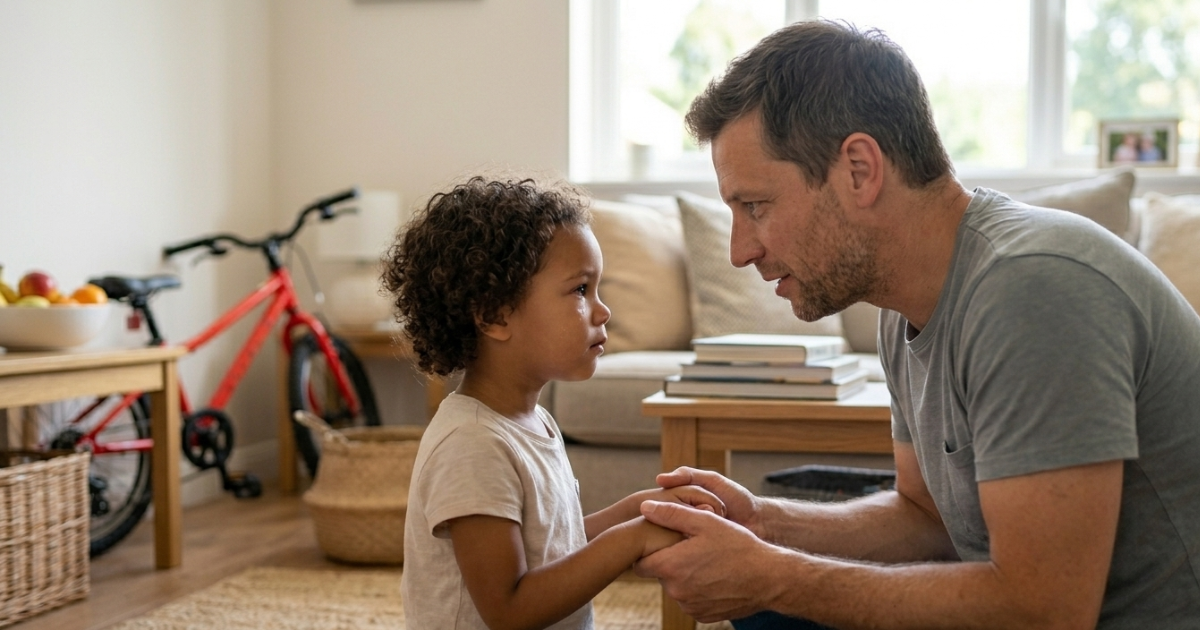
Do not shout. Do not match their energy. Lower your voice, slow your movements, and get down to their eye level. This signals safety.
If your child hits another child, intervene immediately but without aggression. Separate them, acknowledge what happened (“You hit your brother. That is not okay.”), and give a brief time-out or cool-down period of three to five minutes appropriate to their age.
Address it in the moment. Do not wait until later. Young children cannot connect a consequence to an event that happened an hour ago.
2. Name the Emotion
Children often do not know what they are feeling. Giving the emotion a name helps them process it.
“You are feeling angry because your sister took your toy.” “You are frustrated because the tower keeps falling down.” “You are upset because you wanted to stay at the park.”
This is not soft parenting. This is teaching emotional vocabulary. Research from UCLA’s neuroscience department found that labelling an emotion (“affect labelling”) reduces the intensity of the emotional response in the brain. It works for adults too.
Over time, a child who can name their emotions is better equipped to manage them without physical outbursts.
3. Praise the Behaviour You Want to See
Children repeat behaviour that gets attention. If the only time they get a strong reaction from you is when they misbehave, they will keep misbehaving.
Actively notice and praise positive behaviour:
- “You shared your toy with your friend. That was kind.”
- “You told me you were angry instead of hitting. I am proud of you for using your words.”
- “You waited your turn. That was really patient.”
Be specific. “Good boy” is vague. “You handled that really well when your brother took your turn” tells them exactly what they did right and why it mattered.
4. Give Them Your Full Attention
A child who feels seen and heard is less likely to escalate to get your attention.
When you are with your child, put your phone down. Not face down on the table. In another room. Even 15 minutes of genuinely undivided attention each day can reduce attention-seeking behaviours significantly.
During that time, follow their lead. Play what they want to play. Talk about what they want to talk about. Let them direct the interaction. This builds their sense of being valued and reduces the emotional deficit that often drives outbursts.
5. Set Clear Boundaries and Say No When You Need To
Avoiding conflict by saying yes to everything does not prevent anger. It delays it and makes it worse when it eventually arrives.
Children need boundaries. Boundaries create predictability, and predictability creates safety.
Say no clearly and calmly. Explain the reason briefly (“You cannot have another cookie because dinner is in 20 minutes”). Do not over-explain or negotiate endlessly. Accept that your child may be upset about the boundary. That is okay. Being upset is not the same as being harmed.
The goal is not a child who never hears no. It is a child who learns that no is survivable.
6. Channel Their Energy Through Physical Activity
Anger is physical. The stress hormones cortisol and adrenaline flood a child’s body when they are angry, and that energy needs somewhere to go.
Physical activity is the fastest, most effective release:
- Running around the yard or the park.
- Jumping on a trampoline.
- Kicking a soccer ball against a wall.
- Cycling. This post on the benefits of cycling for kids covers how regular physical activity supports both physical and emotional development.
- Dancing, climbing, swimming.
Build physical activity into your child’s daily routine, not as a response to anger, but as a preventive measure. A child who burns energy regularly has fewer explosive outbursts. A child who is sedentary and under-stimulated has more. The Centers for Disease Control and Prevention (CDC) recommends that children aged 6 to 17 get at least 60 minutes of moderate-to-vigorous physical activity every day.
7. Use Non-Verbal Cues
From around nine months, children begin to understand simple gestures and facial expressions. Use these as communication tools:
- A firm shake of the head and a serious expression for “no.”
- A finger to the lips for “let’s be quiet.”
- A thumbs-up for “that was good.”
- Opening your arms for “come here, I am safe.”
Non-verbal cues are particularly effective with younger children who do not yet have the language to process a verbal instruction during a moment of high emotion. They also work when your child is too upset to listen to words.
As children grow, gestures can be agreed in advance. A family signal for “I need a minute to calm down” gives older children a tool they can use before things escalate.
8. Teach Them a Cool-Down Routine
Children do not instinctively know how to calm themselves down. You have to teach them a method and practise it when they are not angry, so it becomes available when they are.
Simple cool-down techniques by age:
- Ages 2 to 4. Blow out birthday candles (deep breathing disguised as play). Hold up five fingers and have them blow each one down slowly. This slows their breathing and activates the parasympathetic nervous system.
- Ages 5 to 8. The “5-4-3-2-1” grounding exercise. Name five things you can see, four you can touch, three you can hear, two you can smell, one you can taste. This redirects the brain from the emotional response to the sensory present.
- Ages 9 and up. Teach them to recognise their early warning signs (clenched fists, tight jaw, hot face) and to remove themselves from the situation before they lose control. Have an agreed safe space in the house where they can go to cool down without it being framed as punishment.
Practise these techniques during calm moments. Role-play scenarios. Make it a game. A cool-down routine only works during a crisis if it has been rehearsed outside of one.
9. Give Choices, Not Commands
A child who feels powerless is more likely to express that through anger. Offering controlled choices gives them a sense of agency without giving up your authority.
Instead of “Put your shoes on now,” try “Do you want to put your shoes on first or your jacket?”
Instead of “Stop yelling,” try “You can tell me what you need in a calm voice, or you can take a minute in your room first. Which one?”
Instead of “Eat your dinner,” try “Do you want to start with the carrots or the chicken?”
The outcome is the same. The shoes go on. The dinner gets eaten. But the child feels like they had a say, which reduces resistance and defiance. Research on self-determination theory consistently shows that autonomy, even in small doses, reduces oppositional behaviour in children.
10. Repair After the Storm
What happens after an outburst matters as much as what happens during it.
Once your child has calmed down (not during the meltdown, after it), reconnect. This is not about rehashing what they did wrong. It is about restoring the relationship and reinforcing learning.
A simple repair conversation:
- “You were really angry earlier. Do you know what made you feel that way?”
- “What happened when you threw the toy? How did your brother feel?”
- “Next time you feel that way, what could you do instead?”
Keep it short. Keep it warm. Do not lecture.
Children who experience consistent repair after conflict develop stronger emotional regulation, better problem-solving skills, and more secure attachment to their parents. Research by Dr John Gottman at the University of Washington found that repair interactions are one of the strongest predictors of healthy parent-child relationships.
End the conversation with physical affection if your child is receptive. A hug, a hand on their shoulder, sitting close together. This tells them that the anger did not break the relationship. That safety is what allows them to take risks with managing their emotions next time.
When Anger Might Signal Something More
Occasional anger is normal. Persistent, intense, or unusually frequent anger may indicate something deeper.
Consider seeking professional advice if:
- Your child’s anger is significantly more intense or frequent than peers of the same age.
- Outbursts regularly last longer than 20 to 30 minutes.
- Your child is hurting themselves or others regularly.
- Anger is accompanied by extreme difficulty concentrating, sensory sensitivities, or difficulty with social interaction.
- Your child’s behaviour is affecting their ability to function at school or maintain friendships.
Conditions such as ADHD, Autism Spectrum Disorder, Sensory Processing Disorder, anxiety, and trauma can all present with anger as a primary symptom.
In the US: Start with your child’s pediatrician, who can provide a referral to a developmental-behavioral pediatrician, child psychologist, or child psychiatrist. Most private insurance plans and Medicaid cover behavioral health evaluations for children. If you do not have insurance, Federally Qualified Health Centers (findahealthcenter.hrsa.gov) provide services on a sliding-fee scale. Your local school district is also legally required under the Individuals with Disabilities Education Act (IDEA) to evaluate your child for free if you suspect a developmental or behavioral condition is affecting their learning.
In the UK: A referral through your GP to a paediatrician or child psychologist can clarify whether additional support is needed. The NHS provides these assessments free of charge.
What Not to Do
Do not spank, hit, or use any form of physical punishment. The evidence is unambiguous. It does not work and it causes harm. The American Academy of Pediatrics, the American Psychological Association, and the UK Royal College of Paediatrics and Child Health all advise against it.
Do not shame your child for being angry. “Stop crying,” “You are being ridiculous,” and “Big boys don’t cry” teach a child to suppress emotions rather than manage them. Suppressed emotions do not disappear. They resurface in other ways.
Do not ignore the behaviour and hope it passes. Consistently ignoring aggression teaches a child that it is acceptable. Address it every time, calmly and briefly.
Do not compare your child to others. “Why can’t you be good like your sister?” creates resentment and damages self-esteem without changing behaviour.
Free Resources for Parents
US Resources:
- CDC Child Development Resources (cdc.gov/childdevelopment): Evidence-based milestones, developmental screening tools, and parenting tips by age.
- Zero to Three (zerotothree.org): Research-based guidance on early childhood development, behaviour, and emotional regulation from birth to age three.
- Child Mind Institute (childmind.org): Free articles and guides on managing anger, anxiety, ADHD, and behavioural challenges in children. Based in New York with a clinical team of child psychologists and psychiatrists.
- American Academy of Pediatrics HealthyChildren.org (healthychildren.org): Parent-facing guidance on discipline, emotional development, and when to seek help, written and reviewed by pediatricians.
- SAMHSA National Helpline (1-800-662-4357): Free, confidential referral service for mental health and substance use disorders, available 24/7. Can connect families with local treatment and support services.
- IDEA Early Intervention Services: If your child is under three and showing developmental concerns, you can request a free evaluation through your state’s Early Intervention programme. Find your state contact at the ECTA Center (ectacenter.org).
UK Resources:
- NHS Child and Adolescent Mental Health Services (CAMHS): Free referral through your GP for children showing persistent behavioural or emotional difficulties.
- Young Minds (youngminds.org.uk): UK charity providing advice for parents on children’s mental health, including a free parent helpline (0808 802 5544).
- Family Lives (familylives.org.uk): Free helpline (0808 800 2222) and online resources for parents dealing with challenging behaviour.
The Bottom Line
Your child is not giving you a hard time. They are having a hard time.
Your job is not to eliminate anger. It is to teach your child what to do with it. That takes time, repetition, and more patience than you think you have some days.
Pick one strategy from this post and use it consistently for the next two weeks. Consistency matters more than perfection. A calm, predictable response from you will do more to change your child’s behaviour than any single technique.

You may also like
-

Healthy Eating for Kids: A Practical Guide for Parents
2 April, 2026