
How to Get Your Child Ready for a New School Term (Without the Last-Minute Panic)
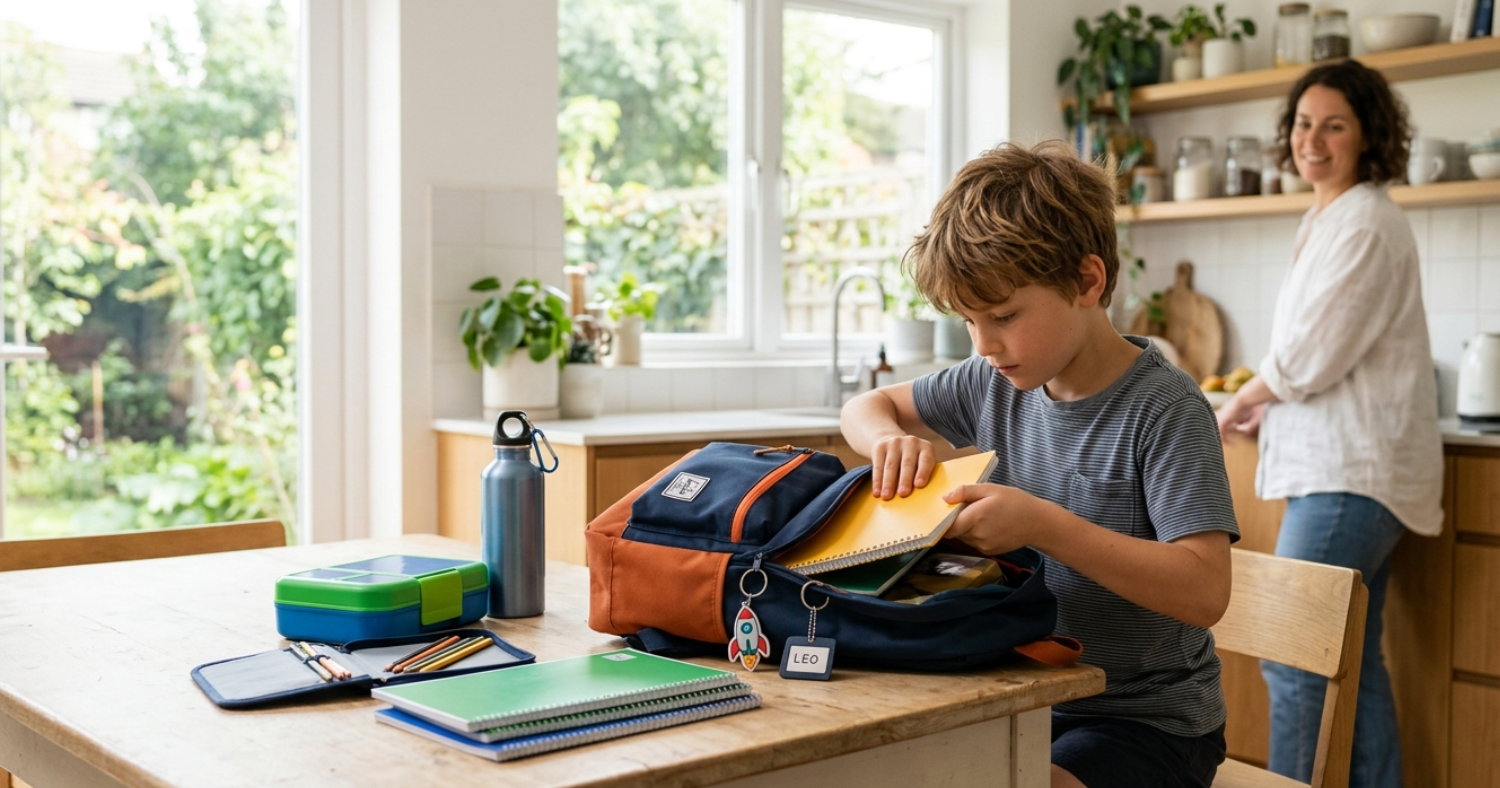
The final week of the holidays always arrives faster than you expect. One day, your child sleeps until 10 am and spends the afternoon in pajamas. Next, you are scrambling for school shoes, hunting for a missing lunchbox, and realizing nobody has looked at a book in six weeks.
It does not have to be like that.
A smooth transition back to school takes about two weeks of small, deliberate adjustments. Not a military operation. Just a few changes to sleep, routine, and mindset that make the first day feel manageable instead of miserable.
Start Two Weeks Out, Not Two Days Out
The biggest mistake parents make is treating back-to-school preparation as a weekend task. Two days is not enough time to reset a sleep schedule, rebuild a routine, and address any anxiety your child is carrying about the term ahead.
Two weeks gives you room to make gradual changes that stick. Here is how to use that time.
Fix the Sleep Schedule First
This is the single most impactful thing you can do. Everything else falls apart if your child is exhausted on the first day.
During holidays, most children drift toward later bedtimes and later wake-ups. Shifting that back by 30 to 45 minutes overnight does not work. Their internal clock needs time to adjust.
The method:
- Starting 10 to 14 days before school, move bedtime earlier by 15 minutes every two to three days.
- Move wake-up time earlier by the same increment on the same schedule.
- By the first day of term, your child should be waking at their school-day time naturally or with minimal resistance.
How much sleep do they need? The American Academy of Sleep Medicine, endorsed by the American Academy of Pediatrics, recommends the following:
- Ages 3 to 5: 10 to 13 hours per day (including naps)
- Ages 6 to 12: 9 to 12 hours per day
- Ages 13 to 18: 8 to 10 hours per day
Children who are consistently under-slept perform worse academically, have more difficulty regulating their emotions, and are more prone to behavioural problems at school. A 2019 study published in JAMA Pediatrics found that children who met sleep guidelines had significantly better cognitive performance, behaviour, and mental health outcomes than those who did not.
Rebuild the Daily Routine Before School Forces It
A child who goes from zero structure to a full school day on day one will struggle. Gradually reintroduce routine in the final week of holidays.
Practical steps:
- Mealtimes. Start eating breakfast, lunch, and dinner at roughly the times they will happen during term. If your child skips breakfast during holidays, this is the week to reintroduce it. Research from the CDC shows that children who eat breakfast have better concentration, memory, and attendance at school.
- Morning routine. Have your child practise the morning sequence: wake up, get dressed, eat breakfast, brush teeth, get ready to leave. Run through it a few times before the real day so it becomes automatic.
- Quiet time. Replace some screen time with quieter activities in the afternoon: reading, drawing, building, puzzles. This helps recalibrate attention spans that have been trained on fast-paced content all summer.
You do not need to simulate a full school day. You just need to close the gap between holiday mode and school mode enough that the first day is not a shock.
Reduce Screen Time Gradually
Cutting screen time cold turkey on the first day of school is a recipe for conflict. Start tapering it a week or two before term begins.
How to do it without a fight:
- Announce the plan in advance. “Starting next week, screens go off at 4pm instead of 6pm so we can get ready for school.”
- Replace screen time with something appealing, not just “go read a book.” A trip to the park, a family game, baking together, or time with friends works better than a void.
- Remove screens from the bedroom at night. The National Sleep Foundation reports that screen use within an hour of bedtime significantly delays sleep onset in children and reduces sleep quality. This rule should carry through the school term, not just the transition period.
Do Some Light Revision Without Making It Feel Like School
If your child has been away from academic work for several weeks, a gentle reintroduction helps. The goal is not to teach new material. It is to wake up the part of their brain that has been on holiday.
Age-appropriate approaches:
- Ages 5 to 7. Read together for 15 to 20 minutes a day. Practise basic math with real-world tasks: counting change at the store, measuring ingredients while cooking, playing card games that involve addition.
- Ages 8 to 11. Review areas where they struggled last term. Use free resources like Khan Academy (khanacademy.org) or BBC Bitesize (bbc.co.uk/bitesize) to revisit specific topics at their own pace. Keep sessions short: 20 to 30 minutes maximum.
- Ages 12 and up. Let them take the lead. Ask what subjects they feel least confident about and offer to help them review. If they resist, do not force it. Teenagers who feel micromanaged will disengage faster than those given some autonomy. This post on parenting teenage boys covers the broader principle of supporting without controlling during the teenage years.
Talk to Your Child About What Is Ahead
Not every child is excited about going back to school. Some are anxious. Some are dreading it. A conversation in the week before term can surface worries you would otherwise miss.
How to open the conversation:
- Start with open questions, not leading ones. “How are you feeling about school starting?” works better than “You are excited about school, right?”
- Listen more than you talk. If your child mentions a worry, resist the urge to fix it immediately. Acknowledge it first. “That sounds like it is bothering you. Tell me more about that.”
- Normalise the nerves. “A lot of kids feel nervous before a new term. That is completely normal.” Knowing they are not the only one feeling that way reduces the weight of the anxiety.
Watch for specific concerns:
- Fear of a particular teacher or subject.
- Worry about friendships or social dynamics.
- Anxiety about academic performance or tests.
- Concerns about bullying.
If your child raises something serious, do not dismiss it. Take it seriously, brainstorm solutions together, and follow up with the school if needed.
According to the Anxiety and Depression Association of America (ADAA), approximately 25% of children aged 13 to 18 experience an anxiety disorder. Back-to-school transitions are a common trigger. If your child’s anxiety seems disproportionate to the situation or is significantly affecting their daily functioning, speak with their pediatrician or GP.
Make the Preparation Enjoyable
Back-to-school shopping does not have to be a chore. Turn it into something your child looks forward to.
- Let them choose their own backpack, lunchbox, or stationery within a budget you set.
- Combine the shopping trip with something fun: lunch out, a trip to the park, or bringing a friend along.
- If your child is starting at a new school, visit the building or walk the route together before the first day. Familiarity reduces first-day anxiety significantly.
The association you create now matters. If back-to-school preparation feels like punishment, your child will dread it every term. If it feels like a positive reset, they will approach it differently.
Set Up the Homework System Before Homework Arrives
Do not wait for the first assignment to figure out where and when homework happens. Set the system up during the transition period.
The essentials:
- A consistent location. A desk in their room, the kitchen table, a quiet corner. It needs to be the same place every time so the habit becomes automatic.
- A consistent time. Some children work best immediately after school while the material is fresh. Others need a break first and work better after dinner. Experiment during the first week and lock in what works.
- No phone during homework. Same rule as study time. Phone in another room. Research consistently shows that the mere presence of a phone, even if it is off, reduces cognitive performance in children and adults.
- Supplies ready. Pens, pencils, paper, calculator, whatever they need should be at the homework station before they sit down. Getting up to find a pencil sharpener is a procrastination trigger.
Encourage Them Without Inflating Expectations
Your child does not need to hear “This is going to be your best year ever.” That creates pressure, not motivation.
What they do need to hear:
- “Last term is done. This is a fresh start.”
- “I know some subjects are harder than others. I am here to help when you need it.”
- “What matters is that you try your best. We will figure out the rest together.”
Focus on effort, not outcomes. A child who is praised for working hard develops resilience. A child who is praised only for results develops anxiety about falling short.
If your child had a difficult previous term, whether academically, socially, or behaviourally, acknowledge it honestly. “I know last term was tough. What do you think would help this time?” Involving them in the solution builds ownership and reduces the sense that school is something that happens to them.
Find What Motivates Them Outside the Classroom
A child who has something they love outside of school is more resilient inside it. Extracurricular activities, hobbies, sports, music, art, coding, volunteering, whatever lights them up.
If your child does not have an activity yet, the start of a new term is a good time to explore one. Ask what interests them. Check what the school offers. Look at local community programmes.
In the US, many school districts and local recreation departments offer free or low-cost after-school programmes. The Afterschool Alliance (afterschoolalliance.org) provides a searchable directory of programmes by state. In the UK, local councils often list free holiday and after-school activities on their websites.
The goal is not to overschedule. One or two activities they genuinely enjoy is enough. The point is having something in the week that they chose, that they look forward to, and that has nothing to do with grades.
Free Resources for Parents
US Resources:
- Khan Academy (khanacademy.org): Free, world-class education in math, science, reading, and more. Covers pre-K through high school with personalised learning dashboards.
- Understood.org (understood.org): Comprehensive resources for parents of children with learning and attention challenges, including ADHD, dyslexia, and executive function difficulties.
- Common Sense Media (commonsensemedia.org): Independent guidance on screen time, apps, games, and media for families. Includes age-specific recommendations.
- CDC Children’s Mental Health (cdc.gov/childrensmentalhealth): Information on anxiety, behavioural disorders, and when to seek help. Includes a developmental milestones tracker.
- Afterschool Alliance (afterschoolalliance.org): Searchable directory of after-school programmes across the US.
- National PTA (pta.org): Resources for parent-school engagement, including guides on supporting homework, communicating with teachers, and advocating for your child.
UK Resources:
- BBC Bitesize (bbc.co.uk/bitesize): Free revision and learning resources for KS1 through GCSE and beyond.
- Oak National Academy (thenational.academy): Free lessons and resources developed by teachers, funded by the UK Department for Education.
- Young Minds (youngminds.org.uk): Advice and support for children’s mental health, including a free parent helpline (0808 802 5544).
- Family Lives (familylives.org.uk): Free helpline (0808 800 2222) for parents dealing with any aspect of family life, including school transitions and behavioural challenges.
The Bottom Line
Getting your child ready for a new term is not about cramming preparation into the last weekend. It is about making small, steady adjustments over two weeks so that the first day feels like a gentle shift, not a sudden stop.
Start with sleep. Rebuild the routine. Have the conversation. Set up the homework station. One change per day across two weeks and your child walks into school ready instead of rattled.

You may also like
-

How to Handle an Angry Child (Without Making It Worse)
2 April, 2026 -

Healthy Eating for Kids: A Practical Guide for Parents
2 April, 2026